


A fire is once again ravaging Substack. This time it’s a dispute over whether Continental philosophy is useless nonsense, spurred by this post by Bentham's Bulldog (he also made a follow-up). The claim from the anti-continental side can roughly be summed up by this representative passage from the first post:
[Continental philosophy is] a hideous admixture of literary analysis, gibberish, and argument. They start by saying some things, then say other things that they suggest follow from the earlier things, and have orderly norms governing the relationship between premises and conclusions. The only problem is that the norms don’t involve the use of either logic or any other sound inference rules.
I like BB and agree with a lot of his stuff, but I think this sentiment of his is way off base! I won’t be responding point by point to the critiques I’ve seen floating around. Rather, I’ll be a good phenomenologist, and go “to the things themselves!”
That is, I’ll be presenting you with passages from Hegel, Heidegger, and Derrida. For each I’ll then go through sentence-by-sentence, giving you the necessary tools to hopefully understand what’s going on. I mean, this is really the only reasonable way I see of getting anywhere with this dispute. There's no point in vaguely musing about quotes taken out of context, or about the general vibes of these fields. The only way to see whether there’s anything of value here is to actually give it a thorough and honest look.
My intent is that the experience you’ll get is one of the passage first seeming like obscure nonsense, and then coming to slowly uncover the ideas. Then once we’re done you’ll be able to reread the passages and understand them on your own.
With this I’m intending to show that 1) Continental philosophy is not mainly gibberish, and 2) Continental philosophers do make cogent arguments—even if the reasoning isn’t always recognizably “analytic” (we’ll get to why that is at the end).
Now, anyone who reads this blog will know that I barely touch continental philosophy if I get a choice—in fact, for a while I had opinions close to those of BB. And I’m still thoroughly analytic-pilled in the sense that I’m much more comfortable thinking and reading about analytic philosophy. But the fact that one field fits my thinking style better than another, doesn’t mean that the other is filled with obscurantist charlatans!
Grab yourself a coffee (or non-caffinated beverage if it's the afternoon), and find a nice place to sit; and then on with the show!
Hegel
While Hegel is prior to the analytic-continental divide, he was mentioned in the BB post as a continental, and he has been the subject of discussion around on notes. Hence I think it’s only fair to include him here.
I’m here taking §§95-96 of the Phenomenology. For context, he is discussing the first stage of consciousness: Sense-certainty. What the stages of consciousness are exactly supposed to be isn’t super straightforward, but for our purposes we could think of them as basically theories of epistemology (*useful oversimplification warning*)—and sense certainty is the most naive theory that Hegel is trying to show to be inconsistent (so that it can be sublated into the next stage (i.e. we give up on it, but keep some of the ideas from it)).
Sense certainty is basically just the idea that we have some sort of immediate knowledge of something—like external objects or sense data. This immediate object of knowledge Hegel calls “the This”. With this I actually think the passage should be reasonably understandable:
95. It is, then, sense-certainty itself that must be asked: ‘What is the This?’ If we take the ‘This’ in the twofold shape of its being, as ‘Now’ and as ‘Here’, the dialectic it has in it will receive a form as intelligible as the ‘This’ itself is. To the question: ‘What is Now?’, let us answer, e.g. ‘Now is Night.’ In order to test the truth of this sense-certainty a simple experiment will suffice. We write down this truth; a truth cannot lose anything by being written down, any more than it can lose anything through our preserving it. If now, this noon, we look again at the written truth we shall have to say that it has become stale.
96. The Now that is Night is preserved, i.e. it is treated as what it professes to be, as something that is; but it proves itself to be, on the contrary, something that is not. The Now does indeed preserve itself, but as something that is not Night; equally, it preserves itself in face of the Day that it now is, as something that also is not Day, in other words, as a negative in general. This self-preserving Now is, therefore, not immediate but mediated; for it is determined as a permanent and self-preserving Now through the fact that something else, viz. Day and Night, is not. As so determined, it is still just as simply Now as before, and in this simplicity is indifferent to what happens in it; just as little as Night and Day are its being, just as much also is it Day and Night; it is not in the least affected by this its other being. A simple thing of this kind which is through negation, which is neither This nor That, a not-This, and is with equal indifference This as well as That—such a thing we call a universal. So it is in fact the universal that is the true [content] of sense-certainty.
In one sense I’m actually doing a big favor to the analytic side in choosing this passage, as I think the argument he is presenting is dogshit. That being said, it is an argument, and while the prose is somewhat archaic, I think what is happening is reasonably clear.
He first says:
It is, then, sense-certainty itself that must be asked: ‘What is the This?’ If we take the ‘This’ in the twofold shape of its being, as ‘Now’ and as ‘Here’, the dialectic it has in it will receive a form as intelligible as the ‘This’ itself is.
So basically, we’re asking sense-certainty to explain what the This is. On behalf of sense-certainty he gives the examples of a “Here” and a “Now.” He then says that these examples will make “the dialectic it has in it” as obvious as the “this” itself. The dialectic here is just the contradiction inherent to the stage of consciousness—so he’s basically saying: “With this example, it’ll be super obvious that sense-certainty is bunk.”
To the question: ‘What is Now?’, let us answer, e.g. ‘Now is Night.’
I think you can figure this one out.
In order to test the truth of this sense-certainty a simple experiment will suffice. We write down this truth; a truth cannot lose anything by being written down, any more than it can lose anything through our preserving it. If now, this noon, we look again at the written truth we shall have to say that it has become stale.
Having made this supposition, we do an experiment: Write down “Now is Night” on a piece of paper. Since writing something down can’t make it false, this should be true as well. But wait a minute! If we then look at it again in the morning, it’s no longer true! What the hell? (I love the expression, that “it has become stale.”)
96. The Now that is Night is preserved, i.e. it is treated as what it professes to be, as something that is; but it proves itself to be, on the contrary, something that is not.
What he means by “preserved” is that we continue to treat the Now as something that really picks out something real—which it what it needs to do for sense-certainty to work. But when we do this, it turns out that it doesn’t pick out anything anymore, because there is no longer any Night.
The Now does indeed preserve itself, but as something that is not Night; equally, it preserves itself in face of the Day that it now is, as something that also is not Day, in other words, as a negative in general.
The Now continues to pick something out—but what it picks out is not Night. Now that it is day, it picks out Day. He says, however “as something that also is not Day.” This might be a little confusing, but the idea is that the Now isn’t exhausted by Day, as that runs into the problem from before. Rather it is “a negative in general,” meaning that what is particular to the now is that it has no particular content, but is always changing. It is negative: not anything in particular.
This self-preserving Now is, therefore, not immediate but mediated; for it is determined as a permanent and self-preserving Now through the fact that something else, viz. Day and Night, is not.
But if the Now is negative in this sense, that shows that it is not immediate. After all, its meaning isn’t determined by anything in particular. Rather it is determined by the context in which it is—by the things around it that it is not.
As so determined, it is still just as simply Now as before, and in this simplicity is indifferent to what happens in it; just as little as Night and Day are its being, just as much also is it Day and Night; it is not in the least affected by this its other being.
So the Now isn’t essentially Day or Night. When it goes from day to night, we still have the same concept of Now, it just picks out different things over time.
A simple thing of this kind which is through negation, which is neither This nor That, a not-This, and is with equal indifference This as well as That—such a thing we call a universal. So it is in fact the universal that is the true [content] of sense-certainty.
What we’ve just described, though, is a universal! The Now is a category which remains the same, while its content changes. So the content of sense-certainty is a universal. And of course, the content of sense-certainty was supposed to be an immediate particular, so this shows that sense-certainty buckles under its own weight.
You’d have to be smoking something really strong to think that this is not an argument—and an argument with premises that the support the conclusion and whatnot. In fact, if we really want, we could make it into a syllogism:
If sense-certainty is correct, then what we immediately known must not be universal.
What is immediately know, given sense-certainty, is the This.
If the Now is a universal, then the This is a universal (because the This can be the Now).
The Now can pick out multiple things, while remaining the same.
Only universals can pick out multiple things, while remaining the same.
So sense-certainty is not correct.
Though I don’t see the point of doing so.
Now, I mentioned that I thought this argument is shit. If you’re interested I see basically 2 problems:
When sense-certainty uses “This” it’s not mentioning the concept, but using it to point to the immediate object of awareness. However, Hegel’s argument seems to assume that sense-certainty must referring to the concept “This” rather than to what the concept is used to pick out.
There is also a problem in giving a verbal explanation in the first place. The object of sense-certainty was supposed to not be mediated by language. But Hegel sort of forces sense-certainty to give a linguistic answer to what is the object of experience. That seems to impose an external standard on sense-certainty, which it wouldn’t agree to using. So the argument fails as an immanent critique to show “the dialectic it has in it.”
That being said, you also see plenty of bad arguments in analytic philosophy. I would find something objectionable about most arguments, since I don’t agree with most positions—so the fact that the argument is bad by my lights doesn’t show that continental philosophy is full of crap.
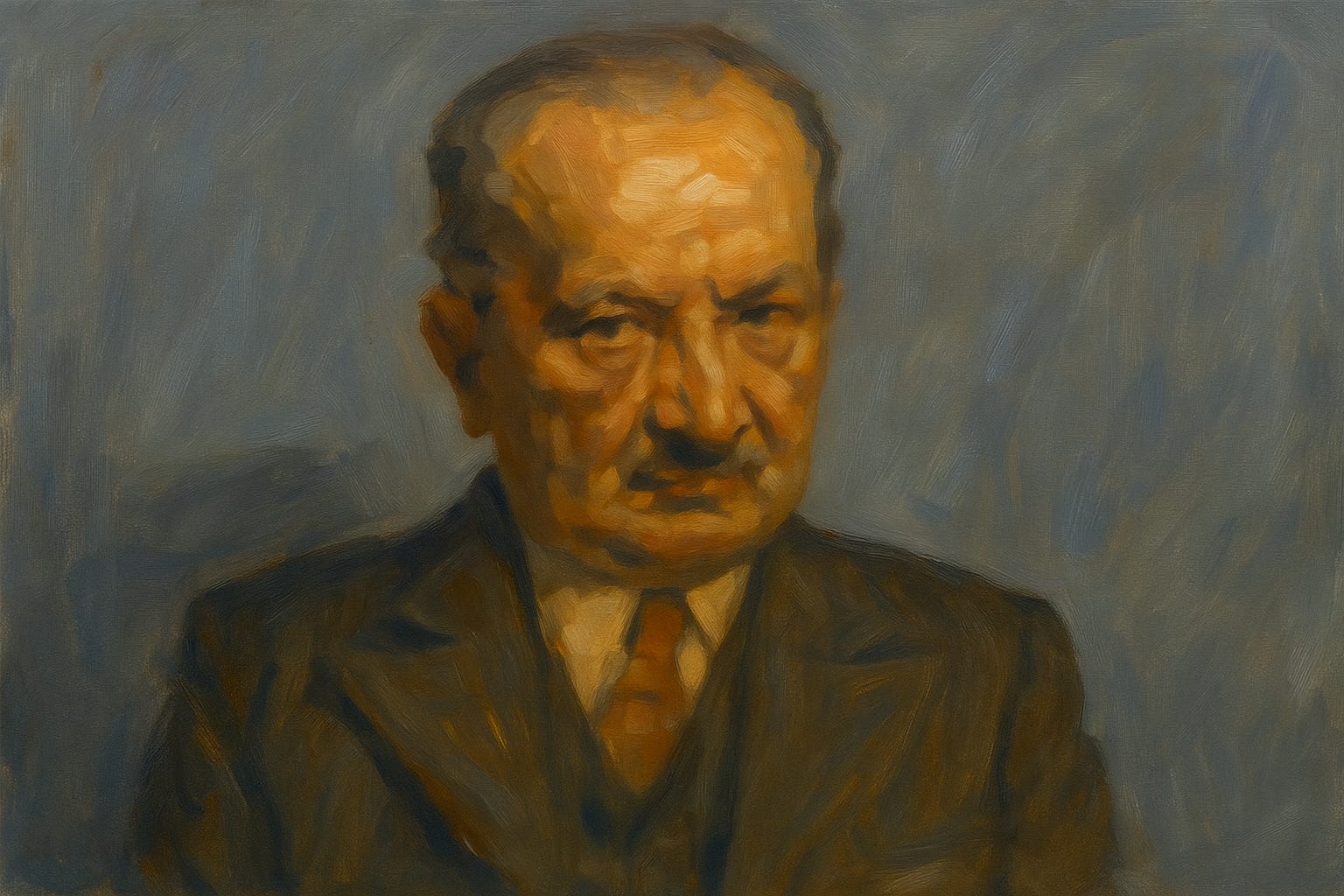
Heidegger
Next up is Heidegger, who we could really consider the father of modern continental philosophy. He is also infamous for being obtuse and obscure. I find that accusation fair for late Heidegger (e.g. in Das Ding) but early Heidegger (i.e. Being and Time) is actually surprisingly understandable when you get what’s going on—at least at times.
Here we’re taking a passage from towards the end of §16 of Being and Time. This time I won’t give you as much context, so that you can get the experience of reading something that is apparent nonsense. Then we’ll make it make sense afterwards:
The structure of the Being of what is ready-to-hand as equipment is determined by references or assignments. In a peculiar and obvious manner, the ‘Things’ which are closest to us are ‘in themselves’; and they are encountered as ‘in themselves’ in the concern which makes use of them without noticing them explicitly—the concern which can come up against something unusable. When equipment cannot be used, this implies that the constitutive assignment of the “in-order-to” to a “towards-this” has been disturbed. The assignments themselves are not observed; they are rather ‘there’ when we concernfully submit ourselves to them. But when an assignment has been disturbed—when something is unusable for some purpose—then the assignment becomes explicit. Even now, of course, it has not become explicit as an ontological structure; but it has become explicit ontically for the circumspection which comes up against the damaging of the tool. When an assignment to some particular “towards-this” has been thus circumspectively aroused, we catch sight of the “towards-this” itself, and along with it everything connected with the work—the whole ‘work-shop’—as that wherein concern always dwells. The context of equipment is lit up, not as something never seen before, but as a totality constantly sighted beforehand in circumspection. With this totality, however, the world announces itself.
This was probably baloney to you—and no wonder, as you’re dropped well into the text, with no context or explanations. Presenting a quote like this makes it out to be pure nonsense, even if it isn’t. So let’s see what we can get out of it:
The structure of the Being of what is ready-to-hand as equipment is determined by references or assignments.
Okay, so “readiness-to-hand” is a way that things can appear to you. It is a way where you don’t tend to the “physical” qualities of an object, but it just becomes an extension of whatever activity you’re engaged in. Think of opening a door: You don’t think about the size and shape of the doorknob, but it just blends in as a part of your activity. It is… ready to hand.
References or assignments here are the purposes of the ready-to-hand. For instance, a hammer “refers” to nails, or is “assigned” to nails. What he’s then saying is that what makes something ready-to-hand is it’s relation in a web of references and assignments.
In a peculiar and obvious manner, the ‘Things’ which are closest to us are ‘in themselves’; and they are encountered as ‘in themselves’ in the concern which makes use of them without noticing them explicitly—the concern which can come up against something unusable.
Here Heidegger is conveying how things appear to us pre-theoretically, rather than giving a statement of what he thinks things are really like. He says that we see “Things” “in themselves” when we are just using them smoothly—you might say when we’re in flow. But he doesn’t actually think that the world is made up of individual things, but rather that things are only ways of “carving up” an entire context; they only exist in this web of significance (he has argued for this earlier).
So when he says that we encounter things in themselves, he is saying that this is how they appear to us when everything is going well.
When equipment cannot be used, this implies that the constitutive assignment of the “in-order-to” to a “towards-this” has been disturbed.
This is a crucial step. When things are not going smoothly—when some equipment turns out to be broken or malfunctioning—that puts a spanner in the works. As he says, it disturbs the link between the “in-order-to” and a “towards-this.”
These are two of the relations that make up the web of significance of the ready-to-hand. The “in-order-to” is the general purpose that I assign a piece of equipment. For instance, the in-order-to of a subscribe-button is to bless your inbox with excellent blog-posts. The “towards-this” is then the concrete goal that you’re using a piece of equipment for—like using a subscribe button for the purpose of getting Wonder and Aporia posts:
And the point is then simply that if something doesn’t work—if the button is broken—then the assignment of a towards-this to the in-order-to of the equipment is messed up.
The assignments themselves are not observed; they are rather ‘there’ when we concernfully submit ourselves to them.
Usually we don’t notice this relation between the towards-this and in-order-to. “Concern” is here a technical term that just denotes the practical, engaged dealings with equipment and tasks in the world. That is, just the kind of activity we’ve been talking about all this time. So when things are going smoothly we just submit ourselves to the relations of significance between equipment, without noticing that they are there.
But when an assignment has been disturbed—when something is unusable for some purpose—then the assignment becomes explicit.
However, when the subscribe button is not working, or when the hammer is broken, we do notice these relations. I think this is pretty plausible. Suppose you’re biking your way to work. When the bike is working as it should, you’re usually not thinking about the relation between the bike and your goal of getting to work on time. But now disaster strikes: The chain jumps off! Oh the horror! At this instant you become painfully aware of what purpose the bike was fulfilling—of how the in-order-to of the bike was assigned to the towards-this of getting to work.
Even now, of course, it has not become explicit as an ontological structure; but it has become explicit ontically for the circumspection which comes up against the damaging of the tool.
Here we get Heidegger’s idea of the ontico-ontological difference. “Ontic” regards particular beings in the world—concrete entities. “Ontological,” on the other hand, regards big-B Being. This is the condition for there being particular beings in the first place.
So he is saying that when the bike breaks, we notice the web of significance itself—we notice that I had to use this bike to get to work. But we don’t necessarily notice the relationality itself. That is, we don’t notice that there are these towards-this relations, and what these are—we’re not doing philosophy yet.
(Circumspection is a particular way that concern is expressed. It is our practical know-how that emerges when things stop working as they should.)
When an assignment to some particular “towards-this” has been thus circumspectively aroused, we catch sight of the “towards-this” itself, and along with it everything connected with the work—the whole ‘workshop’—as that wherein concern always dwells.
What he’s saying here is that not only do we realize that we needed the bike to get to work, but we notice all the chains and networks of towards-this assignments.
That is, when you’re standing there, cold sweat, fiddling with your chain, you don’t just become aware that you have to get to work. Instead, you also start thinking “if I don’t get to work, I might get fired; and if I get fired, I might not have money; and if I don’t have money I…” That is, the whole web of significance becomes apparent.
The workshop is an analogy for the whole context that we are embedded in in our “concernful dealing”—or, as we’ll see, the whole world.
The context of equipment is lit up, not as something never seen before, but as a totality constantly sighted beforehand in circumspection.
When we see the web of significance here, it doesn’t strike us as something we just confabulated out of the blue. We didn’t create it on the spot. Instead the fact that the equipment broke just uncovers the structure that was already there—and we recognize it as familiar, even if we weren’t thinking about it before now.
With this totality, however, the world announces itself.
This is the point we wanted to get to. The part of the book that this passage is taken from is concerned with analyzing the way that we are in the world, and what the world is. Heidegger is arguing against a Newtonian-style picture of the world as a “container” of objects; and he is arguing towards a view of the world as the total network of significance—the “workshop” that we’re doing our work within. This is because he thinks that readiness-to-hand is the primary way in in which things appear to us (as opposed to presence-at-hand which is the more theoretical way of viewing objects as entities “out there”), and so the world we live in is the structure of ready-to-hand equipment.
Now that I have given all this background, I actually think that the passage is very straightforward. There’s not really any unnecessary beating around the bush, and while the language may be more colorful than what you’d find in a Synthese article, I think it delivers the points pretty straightforwardly.
It of course isn’t an argument in the typical sense. But that’s because he’s developing an analysis of our experiences—he’s doing phenomenology. So the argument style isn’t “A, B, therefore C” rather it’s “here is a proposed analysis of our experience, here are some examples, now I hope you can see that this is what is going on when you compare with your own experience.” Really it isn’t much different from the style of argumentation in much of contemporary ethics, where you present cases, and rely on the reader sharing your intuitions.
Derrida
Now we’ve gotten to the big bad punching bag, Derrida. (Well, except for Judith Butler, who I don’t really know much about.) And let me be honest: I think he has the worst shot at beating the allegations. Even so, he becomes a lot clearer once you understand his project and his references.
We’ll be looking at a passage from the essay Différance in Margins of Philosophy, about midway through the text. For context Derrida has just argued that language is not a function of the speaking subject, but that it goes the other way—that the speaking subject is always inscribed in a system of language.
One might be tempted by an objection: certainly the subject becomes a speaking subject only in its commerce with the system of linguistic differences; or yet, the subject becomes a signifying (signifying in general, by means of speech or any other sign) subject only by inscribing itself in the system of differences. Certainly in this sense the speaking or signifying subject could not be present to itself, as speaking or signifying, without the play of linguistic or semiological différance. But can one not conceive of a presence, and of a presence to itself of the subject before speech or signs, a presence to itself of the subject in a silent and intuitive consciousness?
Such a question therefore supposes that, prior to the sign and outside it, excluding any trace and any différance, something like consciousness is possible. And that consciousness, before distributing its signs in space and in the world, can gather itself into its presence. But what is consciousness? What does “consciousness” mean? Most often, in the very form of meaning, in all its modifications, consciousness offers itself to thought only as self-presence, as the perception of self in presence. And what holds for consciousness holds here for so-called subjective existence in general. Just as the category of the subject cannot be, and never has been, thought without the reference to presence as hupokeimenon [substratum] or as ousia [substance], etc., so the subject as consciousness has never manifested itself except as self-presence. The privilege granted to consciousness therefore signifies the privilege granted to the present; and even if one describes the transcendental temporality of consciousness, and at the depth at which Husserl does so, one grants to the “living present” the power of synthesizing traces, and of incessantly reassembling them.
This privilege is the ether of metaphysics, the element of our thought that is caught in the language of metaphysics. One can delimit such a closure today only by soliciting the value of presence that Heidegger has shown to be the ontotheological determination of Being; and in thus soliciting the value of presence, by means of an interrogation whose status must be completely exceptional, we are also examining the absolute privilege of this form or epoch of presence in general that is consciousness as meaning in self-presence.
Thus one comes to posit presence—and specifically consciousness, the being beside itself of consciousness—no longer as the absolutely central form of Being but as a “determination” and as an “effect.” A determination or an effect within a system which is no longer that of presence but of différance, a system that no longer tolerates the opposition of activity and passivity, nor that of cause and effect, or of indetermination and determination, etc., such that in designating consciousness as an effect or a determination, one continues—for strategic reasons that can be more or less lucidly deliberated and systematically calculated—to operate according to the lexicon of that which one is delimiting.
Again, I assume this sounds very confusing.
The first paragraph should be pretty clear though. He basically just anticipates an objection: “Sure, the speaking subject is only a function of a linguistic system; we couldn’t signify (i.e. express meaning with our words) without being part of a system of differences (i.e. a linguistic system [see below]). But surely there is still a sense in which we have some pre-linguistic experience—just some pure ‘presence.’”
When he mentions a “system of differences” here, he’s referring to Saussure’s structuralism, which he is basically building off of in this text. Saussure’s idea is that terms in a language never have any fixed meaning in themselves. Rather terms only come to have meaning in relation to other terms. For this reason he sees meaning as a system of differences between terms, without any of those terms having a meaning in themselves. Basically, meaning is… structural.
Such a question therefore supposes that, prior to the sign and outside it, excluding any trace and any différance, something like consciousness is possible.
Any such pre-linguistic experience would require that there could be consciousness without that consciousness being “inscribed” in a system of differences. Here he uses the words “trace” and “différance” which require a little explanation.
“Trace” is the idea of a mark that the past or future makes on the presence. This idea is more or less something he borrows from Husserl. Husserl argued that we never just experience fixed present “time-slices.” Rather our present experience is affected by “retention” where the past leaves a trace on our present experience, and “protention” where we anticipate the future. He gives the example of listening to a melody, where your present experience both retends the melody right before, and protends what will come next.
Différance is more difficult. It’s a term of art that the whole text here centers around, and is in a sense an extension of Saussure’s theory. For Saussure, terms only get their meaning through difference (in case you already forgot). But Derrida pushes this idea further, applying it to thought, metaphysics, and experience. The best way I can think of spelling it out is that, différance functions like a “transcendental condition” of sense and experience: nothing can appear or make sense except through its relations and distinctions from other things.
But because of this, the idea is sort of paradoxical or self-effacing. Derrida makes it clear that différance is “neither a concept nor a word.” If we try to define différance definitively, we would turn it into a fixed object—a presence—which would contradict its very nature.
This is important because Derrida takes this to show metaphysics—in the sense of searching for stable universal principles—to be misguided. Any such principle would violate différance because it would be something that was “self-sufficient,” if you will. And now he is then looking at consciousness which has been a kind of bastion for metaphysics, and a plausible case of something that is self-sufficient or non-differential.
And that consciousness, before distributing its signs in space and in the world, can gather itself into its presence.
This kind of pre-linguistic experience would also require that we had some kind of conscious presence prior to doing anything linguistic. Presence here is just supposed to be some sort of immediate givenness. The point is that this would be a problem for Derrida, since something like that existing would be a sort of counterexample to différance.
But what is consciousness? What does “consciousness” mean?
I’ll let you figure this one out on your own…
Though I will note that this line marks a shift. Until now, he has been laying out the objection, and the bar it has to meet. But now he goes into the argument. The form of the argument is not a direct refutation, but more of a “genealogical debunking”. He’s going to try and show that presence is not an “innocent” idea, but is already steeped in the metaphysical framework that he’s been arguing against throughout the text this passage is from.
Most often, in the very form of meaning, in all its modifications, consciousness offers itself to thought only as self-presence, as the perception of self in presence.
This is an important shift in language. Once we unpack what consciousness is, it’s not just presence but self-presence. So it is not simply something “there” but something that observes itself to be there. This uncovers a crack for differánce to slip in.
And what holds for consciousness holds here for so-called subjective existence in general. Just as the category of the subject cannot be, and never has been, thought without the reference to presence as hupokeimenon [substratum] or as ousia [substance], etc., so the subject as consciousness has never manifested itself except as self-presence.
Now he’s generalizing: Both consciousness and subjective experience in general he takes to be heavily “theory-laden” ideas. Subjects are conceptualized through substance, and consciousness is, as noted, conceptualized as self-presence.
I take it an important point here is not only that we use metaphysical concepts to think about presence and subject, but that we use concepts at all. That is, they are not just something immediate, but are thought of within a conceptual scheme, understood in terms of their difference from other parts of the structure.
The privilege granted to consciousness therefore signifies the privilege granted to the present;
So the central role of consciousness in the western tradition is really bound up on the less innocent idea of presence, which he has been arguing against throughout this text. He also uses the word “present” instead of “presence” which is playing on their shared root, pivoting into the next line.
and even if one describes the transcendental temporality of consciousness, and at the depth at which Husserl does so, one grants to the “living present” the power of synthesizing traces, and of incessantly reassembling them.
This line is doing two things at once:
First, it is continuing the line of argument above, showing how consciousness is bound up on the metaphysics of presence (and now the present), even up to what Derrida sees as the most sophisticated attempt at a theory of presence—namely Husserl’s.
At the same time, he is pointing to a second line of attack at the end, with the mention of “synthesizing traces” (recall the explanation of “trace” above). The present moment involves protention and retention, so there is no single immediate present—it is always mediated by what comes before and after. Presence is structured and understood through non-presence: each conscious experience is intelligible only in relation to others, with no self-sufficient “time-slice” or privileged starting point. This interrelation of presence and non-presence is precisely what Derrida calls différance.
This privilege is the ether of metaphysics, the element of our thought that is caught in the language of metaphysics.
Here he is sort of wrapping up and giving the conclusion from the previous paragraph: The privilege of presence is deeply metaphysical. It is not some innocent pre-theoretical notion, but one that involves theory-laden ideas like substance, or self-contained time-slices of experience. But we don’t notice it because it’s the “metaphysical air” we breathe.
One can delimit such a closure today only by soliciting the value of presence that Heidegger has shown to be the ontotheological determination of Being;
This is pretty archaic in the phrasing, but basically: One can only escape this assumption by shaking up/putting pressure on the value of presence, which Heidegger has shown to be the ontotheological determination of Being.
So he’s essentially saying that we have to question the idea of presence in order to escape these metaphysical presuppositions. And then he’s pointing out that Heidegger also showed presence to be problematic. This is already quite long, so I won’t go into what “the ontotheological determination of Being” is, but the point is that it’s a mistake.
and in thus soliciting the value of presence, by means of an interrogation whose status must be completely exceptional, we are also examining the absolute privilege of this form or epoch of presence in general that is consciousness as meaning in self-presence.
Basically: In questioning this idea of presence, we’re questioning the entire premise of much of western metaphysics. So the conclusions here are pretty radical.
Thus one comes to posit presence—and specifically consciousness, the being beside itself of consciousness—no longer as the absolutely central form of Being but as a “determination” and as an “effect.”
Given these conclusions, consciousness no longer becomes a fundamental starting point or Being, but more like a determination/property or effect.
A determination or an effect within a system which is no longer that of presence but of différance,
And what it will be a property of will not be a system of stable presence, but the dynamic différance. After all, the reason why presence turned out not to work was that it turned out to be mediated by the sorts of differences that fit with the idea of différance.
a system that no longer tolerates the opposition of activity and passivity, nor that of cause and effect, or of indetermination and determination, etc.,
As I explained earlier, différance doesn’t allow these sorts of stable oppositions, and so these will have to go.
such that in designating consciousness as an effect or a determination, one continues—for strategic reasons that can be more or less lucidly deliberated and systematically calculated—to operate according to the lexicon of that which one is delimiting.
But we still must speak of consciousness in familiar terms. That is, for strategic reasons (which he doesn’t go into here) we should not give up on talk of “presence” or “consciousness,” even if it turns out to technically be misguided.
Okay, so things have hopefully become a lot clearer, and if you reread the passage, you can hopefully get the meaning out of it. And having done this exercise, I hope you can agree that there are some genuinely interesting ideas and moves being made under the surface.
Still—unlike with Hegel and Heidegger—a lot of the difficulty remains once we give the relevant background, just because he uses strange words like “solicit,” and many strange and convoluted sentence-constructions. Once we have the right interpretative perspective in mind, it’s pretty clear, but he really doesn’t give us very good signposting to understand what he’s arguing. In fact, I went through several iterations of how I interpreted his argument here—though I’m pretty sure what I ended up with is correct, and some of the confusion is certainly a result of my unfamiliarity.
If we’re extra charitable to Derrida for a moment, I suspect we can defend his convoluted writing a little, since it supports his project. What he is trying to show is that différance permeates everything, so that no position has any firm foundation. This in turn means that he himself can’t have a settled position, as that would be contrary to différance. And so he has to write in this convoluted way so that he can never be pinned down to any particular position; he has no position.
Make of that what you will.
Concluding Reflections
I hopefully achieved what I set out to: That you see that there is real substance to continental philosophy, and that the difficulty (often) doesn’t come from bad writing, but from lack of prior understanding.
You might be a little confused by my point right now. I mean, if these passages require 3 times the text in exposition to understand, then that obviously just confirms the point that continental philosophy is needlessly obscure!
But notice that now that I have explained these passages, they make sense on their own! Not only that, you'd probably be able to read passages from nearby sections of these works without too much trouble. What I have been doing is not necessarily simplify the writing—but I’ve explained the context, the theoretical background, and the meaning of the terms of art. These passages aren’t nonsensical on their own, they just assume that the reader has certain background understanding; they don’t make sense if just plucked out from nowhere.
Still, you might wonder why introduce all these fancy neologisms in the first place? The answer is in what continental philosophy is generally trying to do. If there’s one thing that all continental philosophers can agree on, it’s that everyone before them was fundamentally confused.
Okay, that might be an exaggeration, but the point is that each of the philosophers we’ve been looking at have been trying to reinvent philosophy from the ground up, departing with many of the traditional assumptions. To do this, they can’t just use the “readymade” concepts of the tradition, but are better off making new terms that don’t have the same connotations. The best example here obviously being Heidegger.
Generally analytic philosophers are working with readymade or folk concepts, or recombinations of these—building on top of each other’s conceptual schemes. This makes it a lot easier to understand quickly, but also means that it takes for granted what continentals might not. What is a relation? For an analytic philosopher it’s an n-place ordered predicate. And for a continental philosopher you get a whole treatise on simply the relation of difference (or différance).
This is actually one place where I think continental does better than analytic. Analytic philosophers can be so caught up on sticking to our commonsense terms, assuming that there’s some important meaning to them, that we end up with decades of gettierology. Continental philosophers of course have their own weird obsession with etymology, but so it goes.
Keeping this difference in scope and approach in mind, I think it’s also clear why it’s rarer to see arguments that it makes sense to set up in a syllogism when reading continental philosophy. To make a deductive argument like that, it requires that you have premises you and your interlocutor agree with. But when you’re trying to rework the foundational assumptions of philosophy, you don’t get that privilege. Instead you have to resort to showing your conclusions and hoping they resonate with your reader—or otherwise develop a whole new approach, like Hegel.
All that being said, I’m not going to pretend that these are written at exactly as clearly as they could. Obviously they aren’t! When I read Heidegger, I still sometimes get the sense that he’s just making overly long sentences, or dropping in random Greek words, because it makes him feel smart. I mean, there is some irreducible complexity, but a lot of the time the complexity comes from choosing confusing formulations, rather than the underlying ideas being hard.
I think we can actually see how the incentives for this would emerge: If the mark of a good philosopher is someone who carves the discipline down to the bone, to the extent that we can no longer rely on our old conceptualizations, then difficulty/confusion becomes a proxy for depth when you don’t yet understand a text. After all, if something is that revolutionary, it will take a real perspective shift to understand. But then when choosing between a clear formulation, or one that conceals the point a little, you’ll generally be incentivized to opt for the latter.
Also, you might just think that I’ve picked out three particularly clear passages. I can say that I tried to pick the Heidegger and Derrida passages more or less at random, though I of course sorted a little to get passages that I thought were interesting and self-contained enough. For Hegel I did have that particular passage in mind beforehand, as I thought it demonstrated a clear argument. But either way there’s obviously gonna be some selection effect, as I won’t present a passage where I have no idea what’s going on.
Oh, and I’m no expert on these thinkers by any stretch of the imagination! This is important for two reasons: 1) If you just give me a random passage from Lacan, or far into the Phenomenology of Spirit or whatever, I won’t be able to explain it to you. But this won’t show that it’s nonsense since—as we’ve seen—understanding such passages often requires a lot of background. And 2) my explanations probably aren’t perfectly accurate. I know I’ve made some oversimplifications, and I wouldn’t put it past myself to have made some outright mistakes as well.
Anyways, that was a very long way of saying that I don’t think continental philosophy is full of crap.
Great article! I’ve been waiting for someone to articulate the point you make near the end. Since Oppy has argued that syllogistic argumentation is only fruitful when it either exposes contradictions in an opponent’s view or forces a revision of one’s own beliefs, I’m no longer convinced that the supposed virtues of analytic philosophy (clarity, rigor, formal structure) are genuine virtues in practice. This is because those two conditions rarely hold in actual discourse. This leaves open the possibility of a rehabilitation of continentals precisely as you articulate it, conceiving of them as positive proposals people, seeking to map conceptual space in a de novo fruitful way for this or that subject. Pieces such as Ellie Anderson's Hermeneutic Labor are clear examples of this.
Great essay! This definitely made the three passages understandable.
However, perhaps this isn't a point in favor of Continentals: the concepts are very interesting, but why don't they simply put forward arguments in the manner you did?
It makes me wonder if there is a real tradeoff between the depth, richness of an *original concept* (not a proposition) and the clarity with which it can be expressed when first developed. I even find this to be the case with most conventionally analytic philosophy. I've read some Wittgenstein & Ryle, and I often don't find their writing to be particularly clear relative to what’s considered clear by the critics of Continental philosophy, although they're undoubtedly very conceptually novel thinkers.
I think it's perhaps somewhat analogous to theorems/propositions and geometric intuition in mathematics & physics.